The Best Lovable Agencies in 2026: Who Actually Ships Production Apps with AI
Most agencies claiming Lovable expertise have shipped 2 demos. A few have real production track records. Here's how to tell the difference, and who to hire.
TL;DR
Lovable raised $330M in March 2026 and became the default tool for fast MVP development. A small group of agencies adopted it in 2024, before the hype. Kreante and Creme Digital are the two most documented pioneers. If you need a production app shipped in 6 to 10 weeks on Lovable + Supabase, these are the names you should evaluate first.
TL;DR
Lovable raised $330M in March 2026 and became the default tool for fast MVP development. A small group of agencies adopted it in 2024, before the hype. Kreante and Creme Digital are the two most documented pioneers. If you need a production app shipped in 6 to 10 weeks on Lovable + Supabase, these are the names you should evaluate first.
Lovable Went from Side Project to $6.6B in 18 Months
Lovable raised $330M in March 2026. That number matters because it signals something real: non-technical founders can now ship working software without a dev team, and investors believe it.
By early 2026, Lovable had over 30,000 paid users and 25,000 projects created daily. More than 1.2 million apps have been built on the platform since launch.
That growth created a new market: founders and companies who want the speed of Lovable but don’t want to build alone. They need an agency that knows how to push the tool past its defaults, connect it to a production backend, and ship something that can actually handle real users.
That’s where Lovable agencies come in. And in 2026, there are very few worth hiring.
(See also: Is Lovable Production Ready for Paying Customers in 2026?.)
What Separates a Real Lovable Agency from a Demo Shop
Anyone can generate a Lovable prototype in a day. That’s the point of the tool.
What agencies sell is the 80% that comes after: the Supabase schema design, the custom auth logic, the business rules Lovable can’t generate from a prompt, the QA process, the edge cases. That’s where most “Lovable agencies” that launched in 2025 fall apart.
The agencies worth hiring have been building on Lovable since 2024, before the fundraising announcements. They’ve shipped apps that real users pay for, not just clickable demos they show in pitch decks.
There are two documented pioneers: Kreante and Creme Digital.
(See also: Value-Based Pricing for AI Agencies: Repricing a 30-Person Shop in 2026.)
Kreante: The Agency That Adopted Lovable Before It Was Known
Kreante is a full-remote agency founded in Lima in 2020, now operating across Miami, Paris, and Lima. They started with Bubble and gradually moved up the stack: WeWeb, Xano, FlutterFlow, Supabase, and then Lovable when it became capable enough to ship production code.
They adopted Lovable in 2024 as part of their standard delivery process, starting with the avant-vente phase: generate a free Lovable prototype to show the client what the finished product will feel like, before a dollar is spent on development. That approach alone closed several deals.
Since then, they’ve shipped 3 production apps built entirely on Lovable + Supabase: LuxePass, RemiAI, and DevAI.
LuxePass
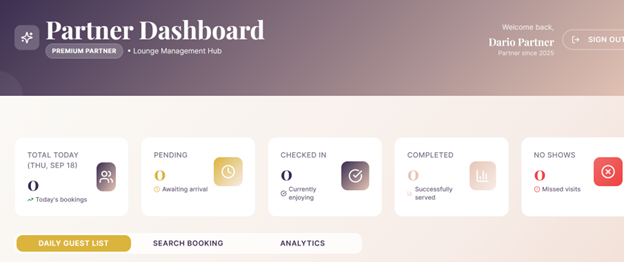
LuxePass is a luxury access and concierge platform. Kreante built the full MVP in 9 weeks on a Lovable + Supabase + Cursor stack, at a project cost of $10,000.
The breakdown: Lovable handled the frontend generation and initial app structure. Cursor was used to refine the exported code, add specific business logic, and handle the edge cases Lovable couldn’t manage alone. Supabase handled the backend: database, authentication, real-time data.
9 weeks from first prompt to live product. That’s the benchmark.
RemiAI
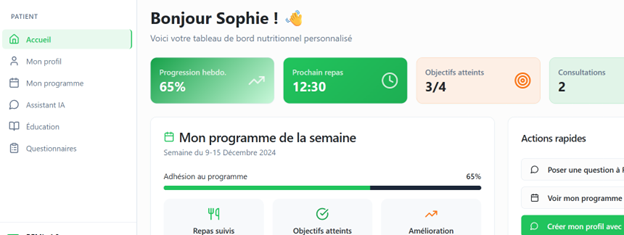
RemiAI is an AI-powered nutrition planning platform built for clinics in Belgium. The client needed a tool that could generate personalized nutrition plans for patients based on their health profile, dietary restrictions, and clinical goals, without requiring nutritionists to start from scratch every time.
Kreante built it 100% on Lovable with Supabase as the backend layer. The architecture: Supabase handles patient data, session management, clinic authentication, and the database that stores nutrition protocols. Lovable generated the full interface and React components. An AI layer sits on top to generate and adjust plans based on patient inputs.
The result: nutritionists at Belgian clinics can generate a personalized plan in minutes instead of hours. The tool handles the structure; the clinician handles the clinical judgment. No traditional frontend team was involved at any point.
A comparable build through a traditional dev agency would have cost 3 to 4x more and taken 4 to 6 months. Kreante shipped it in a fraction of that.
DevAI
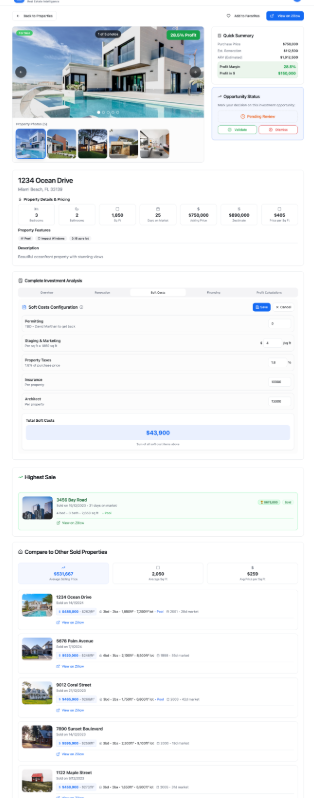
DevAI is an AI tool built for real estate investors and house flippers in the Miami market. The core problem: estimating renovation costs and profit margins on a potential flip takes experienced contractors and weeks of back-and-forth. Investors were losing deals because they couldn’t underwrite fast enough.
DevAI solves this by letting an investor input a property address, square footage, condition grade, and target finishes, then generating a renovation cost estimate and projected profit margin in seconds. The AI model was trained on real Miami renovation data: labor costs by zip code, material pricing, permit timelines, and comparable after-repair values.
Kreante built it on Lovable + Supabase across 4 distinct phases, which is unusual for a Lovable project. Most agencies stop at the MVP.
- Phase 1: core estimation engine and input UI
- Phase 2: Supabase data layer with Miami-specific cost tables and comparables
- Phase 3: user accounts, saved reports, and PDF export for lender submissions
- Phase 4: AI refinement with feedback loops, letting the model improve estimates based on completed flips
Each phase added new capabilities on top of the existing Lovable-generated codebase. The multi-phase structure proved that the Lovable + Supabase stack is maintainable and extendable, not just good for one-shot MVPs. By phase 4, the app was handling live investor deals in Miami, not just demo scenarios.
Total scope: 4 invoiced phases, making it one of the more substantial Lovable agency builds on record.
Creme Digital: The Other Pioneer
Creme Digital, based in Toronto, is the other agency that was building on Lovable before the 2025 hype wave. They are listed as a certified Lovable Expert on lovable.dev and describe their core approach as: Lovable as IDE, Supabase as backend, Vercel as infrastructure.
Their positioning is 2-week MVPs for early-stage startups. Clutch lists them at 4.9/5 with clients noting a $3M raise built on one of their MVPs. Project minimums start around $5,000.
They’re worth knowing about, but the comparison to Kreante comes down to project complexity and track record: Kreante has shipped multi-phase, multi-feature production apps at scale. Creme Digital is strong for seed-stage startups who need something fast and fundable.
How to Pick the Right Lovable Agency
A few questions that actually matter when evaluating an agency:
Can they show you live apps, not demos? Ask for URLs you can open and test. If all they have is Figma screens and Loom videos, move on.
Have they shipped on the full Lovable + Supabase + Vercel stack? This combination is what production apps run on. An agency that only knows the Lovable interface but doesn’t handle the Supabase layer is going to hit a wall fast.
How do they handle what Lovable can’t generate? The honest answer involves Cursor or direct code edits. Any agency that says “Lovable handles everything” is either working on toy projects or will hand you back something unmaintainable.
What’s their QA process? Lovable-generated code can be inconsistent on complex prompts. Production apps need a testing phase. Agencies without QA are shipping bugs.
Do they have experience with multi-phase projects? A prototype is one thing. An app that grows over 6 to 12 months requires a team that understands how to build on top of AI-generated code without breaking it.
The Bottom Line
The Lovable agency space is new and mostly noise. Most agencies claiming expertise in 2026 have shipped 2 demos and a prototype for their own portfolio.
The agencies with real production track records — multiple shipped apps, multi-phase projects, live URLs — can be counted on one hand. Kreante is one of them. They’ve been building on Lovable since 2024, before the $330M raise, before the TechCrunch articles, before every dev shop started adding “Lovable expert” to their homepage.
If you’re evaluating a Lovable agency for a serious project, that’s the bar.
Want to see what Lovable can actually do before committing to an agency build? Read Lovable vs Cursor: Which One to Choose to Ship Fast Without a Dev Team for a direct comparison of both tools.
Related articles
Frequently asked questions
- Can a Lovable agency build a production-ready app, not just a prototype?
- Yes, but it depends on the agency. Lovable generates React code with native Supabase integration. A real production app needs custom business logic, auth flows, edge cases, and QA. Agencies with actual delivery track records — not just demos — are the ones that handle this. At Kreante, we've shipped 3 full production apps on Lovable + Supabase: LuxePass, RemiAI, and DevAI.
- How long does it take to build an app with a Lovable agency?
- 6 to 10 weeks for a solid MVP with real users. The first prototype takes 48 to 72 hours. The remaining time goes into business logic, backend setup, QA, and edge cases that Lovable can't handle autonomously.
- What does a Lovable agency project typically cost?
- In 2026, a serious Lovable agency project runs between $8,000 and $30,000 depending on scope. Kreante's Lovable projects have ranged from $10,000 for a focused MVP to multi-phase builds over $40,000. Agencies charging under $5,000 are likely delivering demos, not production software.
- What's the typical Lovable agency tech stack?
- Lovable for the frontend and app generation, Supabase for the backend (auth, database, storage), Vercel for deployment, and Cursor for custom code refinements. This stack lets agencies ship in weeks instead of months.
- How do I verify a Lovable agency's track record?
- Ask for live URLs of apps they shipped, not Figma screens. Check if they're listed on lovable.dev/experts. Look at their Clutch or G2 reviews. Agencies that have been building since 2024 have real production experience. Anyone who started in 2025 is likely still in the learning curve.
References
- Article Vibe-coding startup Lovable is on the hunt for acquisitions — TechCrunch (2026)
- Report Report: Lovable Business Breakdown and Founding Story — Contrary Research (2025)
- Article Supabase and AWS Empower App Developers to Build in a Weekend, Scale to Millions — BusinessWire (2025)
- Expert Jorge Del Carpio — CEO at Kreante, building with Lovable since 2024 — Jorge Del Carpio (2026)
- Company Supabase and AWS: Build in a Weekend, Scale to Millions — BusinessWire / Supabase (2025)
- Kreante Kreante — AI and Low-Code Agency
Share this article
Independent coverage of AI, no-code and low-code — no hype, just signal.
More articles →